


Beverly Hills Smash and Grab Prevention: 2026 Buying Guide
Updated: 1 day ago
A camera can record a smash-and-grab clearly without slowing the first blow. That’s why smash and grab prevention for storefronts Beverly Hills businesses need goes beyond surveillance alone. Cameras are most useful as part of a coordinated plan that also considers how to delay entry and detect activity. A storefront-specific assessment can help identify which gaps to address first, whether your business is in Beverly Hills, Orange County, or Irvine.
This guide explains how deterrence, detection, and delay work together, and how to compare security measures against your storefront’s layout and operations. You’ll learn how video surveillance, alarms, and access control can support an integrated security plan, while recognizing that cameras alone can’t prevent entry. A clear assessment and coordinated system design make it easier to plan practical next steps.
Table of Contents
Why Smash-and-Grab Prevention Matters for Beverly Hills Storefronts
A 2021 attempted break-in near Rodeo Drive offers local context, but it doesn’t mean every Beverly Hills retailer faces the same exposure. NBC Los Angeles reported that windows at Louis Vuitton and Saks Fifth Avenue were shattered, but nothing was taken and no one entered. The incident shows why security planning should focus on each property rather than assumptions based on an address or headline. The same principle applies to storefronts in Orange County and Irvine.
Effective planning separates three objectives. Preventing access means making entry more difficult or less attractive. Detecting an attempt means creating awareness that a security event may be unfolding. Documenting what happened means preserving useful video or system records for later review. Cameras can support awareness and documentation, but they don’t physically stop forced entry.
A layered storefront security plan coordinates measures to deter an attempt, delay access, detect activity, and document events. Each layer should address risks identified at the property. While retail storefronts primarily focus on site-level physical measures, organizations managing broader operational exposure across complex environments often rely on dedicated risk management firms like Tactical Troop to coordinate comprehensive security protocols.
The phrase Smash and grab (crime) describes a rapid theft involving forced entry, often by breaking a display window. That broad definition frames the concern, but a useful security assessment goes further. It examines how the store’s design, operations, and surroundings shape its specific vulnerabilities.
What the Rodeo Drive incident can and cannot tell retailers
The reported 2021 attempt involved two storefronts near Rodeo Drive. Windows were shattered, but the report said nothing was taken and nobody entered. Those details make the event relevant local context, not proof that other retailers face the same risk or will experience a similar attempt. Each store needs an assessment grounded in its own layout and operating conditions.
Which storefront conditions deserve an initial review?
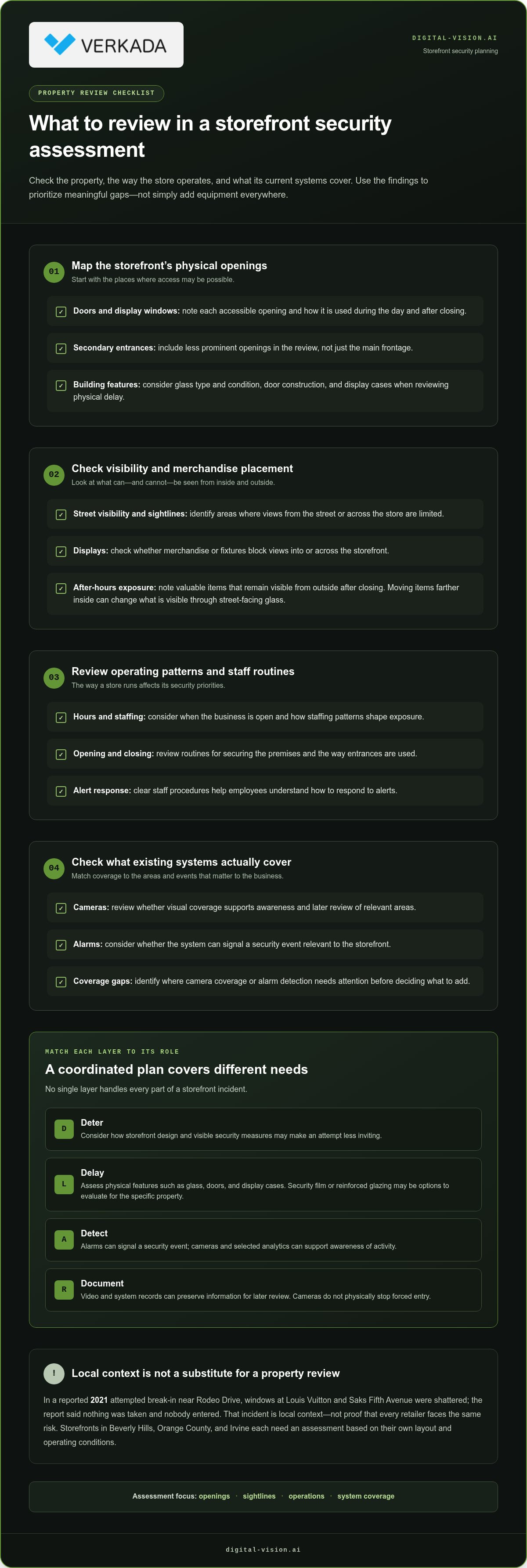
Start with physical openings: doors, display windows, and secondary entrances. Then consider street visibility, sightlines across the frontage, and whether merchandise displays block views into or across the store. After-hours exposure matters too, especially when valuable items remain visible after closing. These details help determine where physical delay may be relevant and where camera coverage or alarm detection needs attention.
Next, review how staff use the space. Business hours, opening and closing routines, merchandise placement, and existing systems all affect priorities. Staff procedures are a separate layer from the building’s openings and the system’s detection coverage. Clear routines help employees understand how to respond to alerts and secure the premises.
Frontage and entrances: Note each accessible opening and how it is used during the day and after closing.
Sightlines and displays: Identify areas where views from the street or inside the store are limited.
Operating patterns: Consider staffing, hours, and routines that shape exposure.
Existing coverage: Review whether cameras and alarms address the areas and events that matter to the business.
For a broader look at camera placement and planning, the Beverly Hills AI camera installation guide offers related context. The goal isn’t to add equipment everywhere. It’s to identify meaningful gaps and match coverage to the storefront’s needs.
How Layered Smash-and-Grab Security Works at a Storefront
Layered security brings together measures with different purposes. Deterrence can make a storefront less inviting, physical delay can make entry more difficult, detection can alert people to activity, and surveillance can help document events. For smash and grab prevention for storefronts Beverly Hills retailers should assess how these functions complement one another, rather than treating cameras as a complete solution. The same approach applies to retail properties in Orange County and Irvine.
No single security layer can deter, delay, detect, and document every part of a storefront incident. Cameras support awareness and later review, but they don’t physically stop forced entry. Alarms can signal a security event, while building features address the opening itself. A coordinated plan connects these roles to the property’s layout and operating needs without assuming any measure guarantees a particular outcome.
Physical delay and storefront design
The physical layer starts with the storefront itself. Glass type and condition, door construction, display cases, and merchandise placement all affect how exposed the space may be. For example, valuable items displayed directly behind street-facing glass may draw attention, while moving them farther inside can change what is visible from outside. Review these design choices alongside entry points and after-hours exposure.
Security film or reinforced glazing may be options to assess based on the existing windows and the property’s design. These building measures are distinct from electronic surveillance and alarm systems. Their suitability depends on the storefront, and they should be considered as part of a broader plan, not assumed to eliminate forced-entry risk. Doors and display cases matter too. Protecting one surface while overlooking another opening can leave a gap in the physical layer.
Detection, alarms, and coordinated visibility
Video surveillance, intelligent analytics, and alarms have different roles. Cameras provide visual coverage for awareness and review. Analytics, when included in the system design, can help interpret selected activity in a camera view. Alarm services provide another detection layer by signaling designated security events. Their value depends on how they are planned for the storefront, not simply on whether equipment is present.
Integration can coordinate relevant security components, so the design reflects the relationship between cameras, alarms, and access control. For instance, a camera may cover a public-facing entrance while an alarm is configured around the business’s security needs. These systems don’t replace staff procedures or physical delay, but a considered design can clarify their respective roles. The commercial alarm installation checklist provides additional planning context for alarm-system decisions.
Deterrence: Consider whether visible, well-planned security measures communicate that the storefront is monitored.
Delay: Review glazing, doors, displays, and merchandise placement as parts of the building’s physical design.
Detection and documentation: Match camera coverage and alarm functions to the events the business needs to detect and review.
A professional assessment can connect these layers to a specific storefront. Digital-Vision.AI offers a storefront security assessment to identify priorities for a coordinated system plan.
Compare Storefront Security Options Without Relying on Cameras Alone
Each security measure addresses a different part of a storefront’s exposure. Compare options by role, value, and limitation to see where each might fit, without treating any single component as a complete answer. For smash and grab prevention for storefronts Beverly Hills businesses can use this framework to match measures to the openings, merchandise, and operating needs identified in an assessment.
When physical storefront measures should be part of the plan
Consider physical upgrades when an assessment identifies a vulnerable opening or merchandise display that increases exposure. Glazing and display-case measures address the building and its contents; cameras and alarms address electronic visibility and detection. They solve different problems, so a storefront may need one measure, several, or another combination depending on its design. Evaluate any proposed building change for its fit with the property and its requirements.
For example, if valuable merchandise sits close to a street-facing window, review both how visible the display is and whether the glass or case warrants attention. A camera may help document activity near that area, but it can’t add physical resistance to the window. A physical upgrade, in turn, doesn’t provide the visual record or alerting function of an electronic system.
When integrated cameras and alarms add decision value
Surveillance and alarms can complement one another when each has a defined purpose. Cameras contribute visual coverage for awareness and review; alarm components can signal selected events. Intelligent analytics may help organize or interpret video activity, depending on the system design, but they aren’t a substitute for physical measures and don’t guarantee that an incident will be identified.
Integration is most useful when it reflects actual site conditions. A narrow entrance, multiple customer access points, a rear service door, and different opening or closing routines can each shape priorities. System design should account for the storefront layout, business operations, and gaps identified during assessment. This makes it easier to compare options based on what they contribute together, rather than judging cameras, alarms, or building measures in isolation.
A Beverly Hills Storefront Security Buying Guide: Assess, Prioritize, Integrate
A useful buying plan starts with the storefront, not a preselected device list. For smash and grab prevention for storefronts Beverly Hills retailers should first understand how the property is used, where its exposure lies, and which existing systems can be coordinated. Business hours, merchandise value and placement, staff workflows, and current cameras, alarms, or access control all affect what deserves priority. Retailers in Orange County and Irvine can use the same site-specific approach.
Follow a clear sequence: map the site, identify vulnerabilities, prioritize measures, design the system, install it, then maintain it. This keeps decisions grounded in the property and gives every component a defined role. A small storefront with one main entrance won’t necessarily need the same plan as a shop with several public and service doors.
Questions a useful storefront assessment should answer
A site-specific review should clarify where visibility, access, and operations intersect. Consider these questions before selecting equipment:
Which doors, windows, and other openings need attention during business hours and after closing?
Where do street-facing or interior sightlines make it harder to monitor an entrance, display, or staff area?
How do existing cameras, alarms, and access-control components work together, and where are the gaps?
Which identified concerns call for a building improvement, electronic detection, or coordinated measures?
Answers should reflect how the business operates. A display that changes seasonally, a rear entrance used for deliveries, or a closing routine that leaves one area unattended can affect priorities. The Beverly Hills security consulting guide provides related context on using an assessment to shape a security plan.
Turn findings into a practical system plan
Once the findings are clear, rank them by relevance to the storefront’s needs. If an assessment identifies limited visibility near an entrance, camera placement may be a priority. If alarm and access-control components already exist, the plan can consider how they fit with new surveillance rather than duplicating equipment. Consider physical building improvements separately from electronic systems, since each addresses a different part of the risk.
Design and installation should account for customer flow, staff routines, and business operations. A system that disrupts opening, closing, or daily work is harder to use consistently. Include maintenance and technical support in the system’s life cycle, so the installation can remain aligned with the business as its layout, practices, or security priorities change.
Digital-Vision.AI provides commercial security consulting and designs and installs video surveillance, alarm, and access-control systems around identified property needs. Request a storefront security assessment to begin mapping priorities and planning a coordinated approach.
Integrate Storefront Cameras, Alarms, and Access Control with a Professional Plan
A coordinated storefront security system starts with the property’s assessed needs, not a standard equipment package. Digital-Vision.AI designs and installs commercial video surveillance, alarm, and access-control systems, aligning each component with the priorities identified for the site. This gives retailers in Beverly Hills, Orange County, and Irvine a practical way to plan smash and grab prevention for storefronts Beverly Hills properties can tailor to their layouts and daily operations.
Integration connects each system’s role. Cameras can provide visual coverage for awareness and review, alarms can signal designated security events, and access control can manage entry to selected areas. Plan these components together around storefront priorities, rather than treating them as separate purchases. They support a coordinated security plan, but no system can guarantee that an incident will be prevented or that a particular response will follow.
What a tailored commercial security installation addresses
A professional plan translates assessment findings into system choices. If a review identifies a storefront entrance with limited visibility, the design can include surveillance coverage for that area. Where alarm functions or controlled access address an identified need, those components can be incorporated into the site plan. The goal is to give each element a clear purpose and fit the design to the property, rather than add technology without a defined role.
Digital-Vision.AI provides high-definition video surveillance with intelligent analytics as part of its commercial security offering. Analytics can be included in a system designed around the property, without assuming that a specific event will always be detected or identified. Alarm services and access-control solutions can also be integrated where they support the storefront’s security priorities. Professional installation brings the planned components together, while maintenance and technical support help support the system over time.
Business operations matter throughout the process. Customer flow, staff routines, entrances used for deliveries, and existing equipment can all inform system design and installation planning. A tailored approach aligns security components with how the storefront functions, rather than imposing the same configuration on every business.
Plan the next step for a Beverly Hills storefront
Digital-Vision.AI is based in Beverly Hills and serves commercial properties across Southern California, including Orange County and Irvine. A free security assessment offers a starting point for reviewing the storefront, identifying priorities, and shaping a plan for video surveillance, alarms, and access control. The process can include tailored system design and professional installation, along with integration, maintenance, and technical support.
To begin planning a coordinated approach for your storefront, request a free storefront security assessment.
Make Your Next Security Decision Count
A storefront’s security plan should remain useful as the business evolves. New displays, changes to opening hours, renovations, or shifts in staff routines can alter what deserves attention. Treat the initial assessment as a practical baseline, then revisit priorities when the space or its operations change. This keeps smash and grab prevention for storefronts Beverly Hills businesses rely on connected to real conditions, rather than outdated assumptions.
The next step doesn’t need to be a full system overhaul. Start by identifying one or two questions for the assessment, such as whether key entrances are covered or how existing components work together. A focused review can clarify which improvements matter now and which can be considered later, helping you make thoughtful decisions without adding technology for its own sake.
Request a free storefront security assessment and take a clear first step toward a plan shaped around your property. With a considered approach, you can move forward with greater confidence.
Frequently Asked Questions
Can security cameras prevent a smash-and-grab attempt?
No. Cameras can’t physically stop an attack, though well-planned coverage may support awareness of activity and provide footage for later review. Their usefulness depends on system design and site conditions, including camera position and what each view captures. For smash and grab prevention for storefronts Beverly Hills businesses should consider cameras alongside physical storefront measures and alarms, not as a stand-alone guarantee of prevention or identification.
Is security film enough to protect a Beverly Hills storefront?
No single measure addresses every storefront risk. Film or other glazing measures relate to the glass, while doors, interior layout, merchandise placement, and business routines create additional considerations. Physical reinforcement serves a different purpose from surveillance and alarms, which support visibility, detection, or review. An assessment can help determine whether glazing is relevant to a particular property and how it fits into a broader plan, without assuming a specific result.
What happens if a storefront security system loses internet connectivity?
System behavior during an internet outage depends on its configuration, communications path, and installed components. Don’t assume that recording, alerts, or alarms will continue unchanged without connectivity. During professional system design, identify which functions depend on a connection and document what staff should do if service is interrupted. Clear outage procedures help employees follow a consistent process while the system’s status is assessed and normal operation is restored.
How often should a storefront security system be checked?
Follow the maintenance plan for the installed system rather than relying on a universal inspection interval. Review it sooner after a remodel, a change to business hours, equipment adjustments, or a shift in how staff use entrances. Routine checks can include camera views, alarm components, and general system operation. Keeping a record of changes or issues gives maintenance and technical support teams useful context for ongoing system care.
Does storefront merchandise placement affect smash-and-grab prevention?
Yes. Window displays affect what is visible from the street and how readily merchandise may be reached through an opening. Review where high-value items sit, whether shelving blocks useful sightlines, and how displays are arranged after closing. Seasonal changes can alter visibility, so include display updates in a property-specific security review. Rearranging merchandise may reduce exposure in some circumstances, but it shouldn’t be treated as a complete security measure.
What should employees do during an attempted storefront break-in?
Employees should put personal safety first and avoid confronting suspected offenders or risking injury to protect merchandise. Follow the business’s established emergency procedures and contact emergency services when appropriate. Staff shouldn’t approach a damaged entrance while danger may remain. Once the immediate threat has passed, preserve relevant information, such as available system records, and follow the property’s incident-reporting process. A clear, practiced procedure helps employees understand their priorities under stress.

Comments