


Insurance discounts for business security systems in California
Documented security measures may reduce relevant business insurance premiums in California by 5% to 15%, depending on industry, location, and claims history. The right equipment alone doesn’t establish eligibility: insurers may weigh what protections are in place and how clearly the business can document them. That’s the key to understanding insurance discounts for business security systems in California.
It’s reasonable to expect that stronger protection could affect insurance costs, but discount rules and qualifying features vary by carrier and policy. A camera, alarm, or access-control system may support your case, yet the insurer’s criteria determine whether it counts toward a premium reduction.
This guide explains what measures to document, what to prepare, and what to ask the insurer about eligibility and potential savings. It also covers how to discuss your setup during a policy review, so you can clearly explain what the system does and how it supports your business.
Table of Contents
Premium discounts for documented security measures
California businesses may see premium reductions of 5% to 15% on relevant coverage lines when they document security measures. Industry, location, and claims history affect how insurers assess those measures.
Documented measures and premium reviews
Build a concise record of installed protections, service dates, and operating procedures. For example, connect a camera inventory with maintenance records and written alarm-response procedures. Clear records help insurers assess the controls in place rather than relying on a general description of “security.” The 5% to 15% range applies to relevant coverage lines, not automatically to every policy or business.
Cyber insurance premiums involve separate digital safeguards. Strong passwords, multifactor authentication, encryption, tested security protocols, employee training, and processes for detecting and responding to threats can help lower them. Cyber underwriters may require multifactor authentication, endpoint detection and response, privileged access management, and tested backup protocols before binding coverage. For businesses evaluating tools to satisfy these requirements, alternativeradar.com can help teams discover and compare software alternatives across different digital services.
California’s Department of Insurance approved a 15% increase for homeowners’ insurance. That action concerns home insurance, not a business security discount, so it shouldn’t be used as a commercial premium estimate.
Deductibles and Premium Savings
A deductible is the amount a business pays toward a covered loss before insurance pays the remaining eligible amount. Increasing a deductible by $500 could lower the premium, but it also raises the business’s out-of-pocket share after a claim. Compare the premium change with the amount the business can absorb, and review the deductible alongside coverage limits and likely loss scenarios.
Coverage Effects and Claim Exclusions
A security system may be relevant when an insurer assesses commercial property risk, but don’t assume it reduces commercial property, general liability, and workers’ compensation premiums alike. Each line covers different exposures, so ask how the system relates to the specific coverage under review.
For a business interruption claim, the business must show that the interruption resulted from a covered peril, caused a financial loss, and was not preventable. A camera recording or alarm log can help document events, but it does not replace those policy requirements. Review the policy’s covered perils and exclusions to understand whether a particular loss qualifies.
Asking insurers which security measures qualify for discounts
Discount eligibility depends on the insurer’s criteria and the wording of the business insurance policy. Ask about each coverage line separately: a measure relevant to property protection may not affect another type of coverage.
Policies With Security Discounts
A security discount is a premium credit tied to protective measures recognized under a specific insurance policy. Commercial property coverage is the most direct place to ask about physical security, while general liability and workers’ compensation address different exposures.
Which business insurance policies offer discounts for security systems in California? Commercial property policies are the clearest fit to discuss, but insurers set their own credits and eligibility rules. Ask the agent to identify the exact policy and coverage line affected instead of assuming one security feature reduces every premium.
Discuss business interruption coverage separately. Security records can help document an incident, but a claim still depends on the policy’s covered peril, financial loss, and preventability requirements.
Monitored Alarms and Loss-Prevention Credits
A monitored-alarm credit recognizes a system that sends an alert to a monitoring service; other loss-prevention credits reflect different protective measures. Ask how each measure is evaluated and recorded, since eligibility for one credit does not establish eligibility for another.
How do California insurance discounts for monitored alarms compare with other loss-prevention credits? The insurer’s policy criteria determine the comparison, not a universal ranking. For context, AAA homeowners policyholders in California can receive a 5% discount for a centrally monitored burglar alarm, but that residential example doesn’t establish a business discount. Ask the agent to compare eligible business credits on the same policy.
Requesting a Security-System Discount
Requesting a discount means asking the insurance agent to compare documented protections with the insurer’s eligibility criteria. This connects each device or procedure to the relevant coverage line.
How can a California business request a security-system discount from its insurer? Send the agent an inventory of installed measures, monitoring details, maintenance records, and relevant operating procedures. Ask which features qualify, what documentation the department or underwriting team needs, and whether the credit changes the premium or policy terms.
For a clearer record of installed camera coverage, organize security system documentation around locations, functions, and maintenance history.
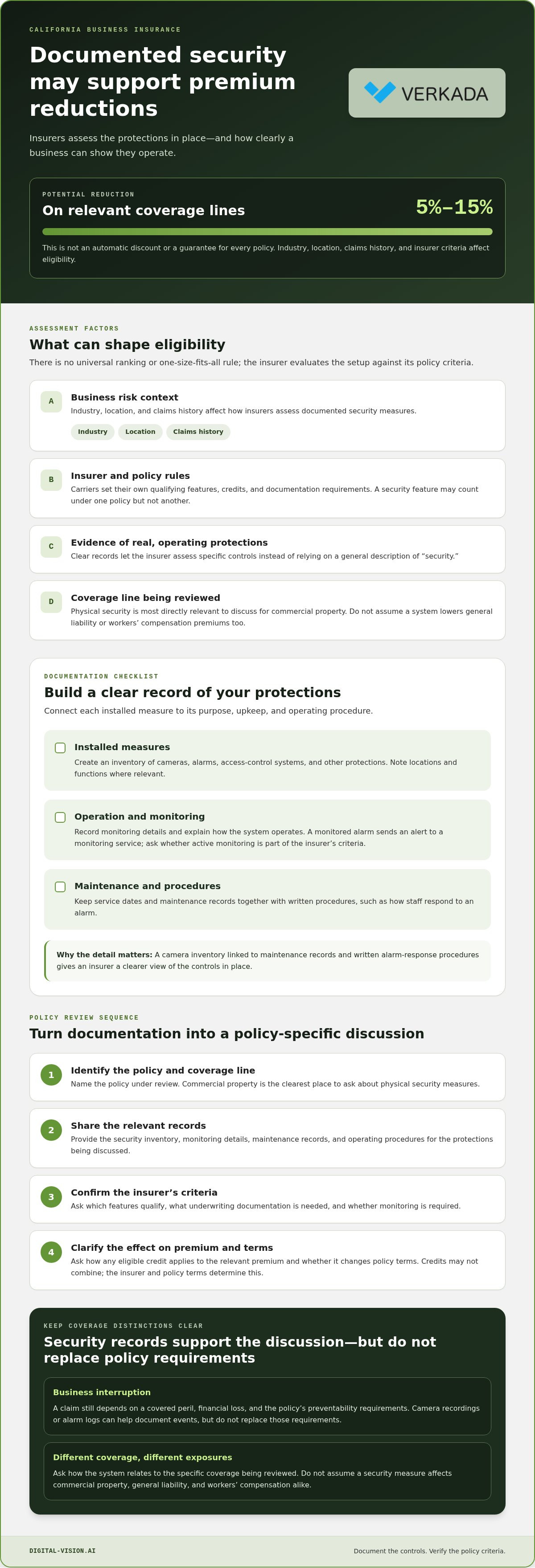
Discussing security discounts with an insurance carrier
Prepare a focused policy review rather than asking only whether cameras earn a discount. Identify the insurer, policy, coverage line, security measures, and records for review. For example, separate property protection from measures intended to reduce employee or operational risks. This keeps the discussion tied to the exposure each policy covers.
Can security-system discounts be combined with other business insurance discounts in California? The insurer and policy terms determine whether eligible credits can be combined. Ask the agent to show how each credit applies to the relevant premium and whether one affects another.
After at least 90 days of consistent security coverage, request a policy review or risk assessment. Bring records showing when the system became operational and how it has been maintained. If a system was added after an incident, include the installation date and any updated operating procedures. That timeline helps the carrier distinguish ongoing risk controls from temporary changes.
Use a short agenda to make the review specific:
Name the policy and coverage line under review.
Describe the installed measures and the risks each addresses.
Provide dated maintenance, monitoring, or incident records.
Ask which credits apply and how they affect the policy premium.
Claims history matters during renewal discussions. After a theft, vandalism, or break-in claim, a California insurer may require added security as a renewal condition or drop coverage. Ask what changes the carrier expects, how compliance will be documented, and whether the requirements affect renewal terms. Keep the response with your policy records.
Keep commercial and personal policies distinct. A homeowners insurance credit does not establish that the same measure qualifies under a business policy. Ask the agent to assess your business’s policy language and risk profile. If the answer is unclear, request the applicable criteria in writing, including which records support the review and when any adjustment takes effect.
Potential savings from security systems
To assess insurance discounts for business security systems in California, compare the insurer’s updated premium with the prior premium for equivalent coverage. Keep limits, deductibles, and covered locations consistent in both figures. Otherwise, a policy change may look like a security credit when it reflects different terms. Request a breakdown that identifies any credit separately.
California businesses can also evaluate savings by coverage line. If the insurer applies a credit to property coverage, assess that line’s change separately from the total insurance package. This makes it easier to see whether the adjustment relates to the protection connected to the installed system rather than unrelated coverage.
Before renewal, organize a comparison showing the system’s purpose, the coverage under review, and the carrier’s calculation. For example, note whether a monitored alarm protects a storage area or cameras document activity at a delivery entrance. These details make the premium discussion specific without assuming the same credit applies to every policy.
California’s insurance discounts for business security systems depend on the carrier’s criteria and the risk information it evaluates. A system’s ability to detect or record an incident may support risk management, but assess savings against the actual premium adjustment and policy terms. Ask how the credit applies if the system protects only part of a property.
Keep residential examples separate from commercial estimates. A homeowners’ credit or savings calculation does not establish what a business policy will provide. Use the business’s own renewal documents to evaluate the financial effect, and consider the security system’s operational value alongside any premium change.
To align protection with your business’s needs, plan a business security system review around the areas, entry points, and events that matter most.
Digital-Vision.AI: Video Surveillance Systems
Digital-Vision.AI helps businesses in Beverly Hills, Orange County, and Irvine plan video surveillance around their property, operations, and security priorities. A well-planned system can help document camera coverage and installed measures when you discuss risk controls with an insurance carrier.
Turn to Digital-Vision.AI when you’re assessing surveillance needs or coordinating cameras with alarms, access control, or existing security infrastructure. Consulting and integration services can align these components with how your business operates. Insurers set their own discount criteria, so system documentation supports the discussion but does not determine whether a policy credit applies.
For a practical next step, identify the areas and events your business needs to monitor, then consider how recorded information will support your security records. Contact Digital-Vision.AI to discuss video surveillance for your business.
Make your next security decision with clarity
Use your insurance review as one input to a broader security plan. The right setup should reflect how your business operates, what needs protection, and how staff respond to an event. This alignment helps you maintain useful records and explain the purpose of each measure.
When considering insurance discounts for business security systems in California, keep the insurance decision and system design connected but distinct. Your carrier determines policy eligibility; your security plan should address real operational needs. Surveillance, alarms, and access control can work together in a coordinated approach, with each component serving a clear role.
Digital-Vision.AI can help you consider those security priorities and plan a system suited to your business. Contact Digital-Vision.AI to discuss your goals, and take the next step with a thoughtful, well-documented approach.
Frequently Asked Questions
How do I know what qualifies for insurance discounts?
A security measure qualifies when an insurer’s criteria recognize it for a specific policy and risk. Match each feature to the exposure it addresses. For example, note whether an alarm protects a storage area or cameras cover a loading entrance. Record what is installed, where it operates, and how it is maintained, then compare those details with the insurer’s criteria.
How much can California businesses save on insurance with alarm or surveillance systems?
California businesses may see reductions of 5% to 15% on relevant coverage lines when security measures are documented. The applicable amount depends on industry, location, and claims history. Treat that range as a possible reduction to eligible coverage, not a calculation for every policy premium. Ask the insurer to show which line the credit affects and how the revised premium is calculated.
Which security devices qualify for commercial insurance discounts: alarms, cameras, access control, or monitoring?
Eligibility depends on the insurer’s criteria, so no device category automatically qualifies across commercial policies. An insurer may assess an alarm’s monitoring arrangement, camera coverage of vulnerable areas, or access controls that limit entry. Describe each component’s purpose and operation. For example, explain which doors use controlled access and which areas cameras cover, rather than submitting only a generic equipment list.
Do California insurers require professional installation or 24/7 monitoring for security discounts?
No single requirement applies to every commercial policy; the insurer’s eligibility terms determine whether installation or monitoring matters. Ask whether the carrier needs installation records, an active monitoring agreement, or specific operating details. A monitored alarm and a local-only alarm may be assessed differently, so describe the system accurately rather than assuming one arrangement meets every policy’s criteria.
Which California commercial insurers offer security-system discounts, and what are their eligibility rules?
Commercial discounts and eligibility rules are insurer-specific, not governed by one statewide list of qualifying systems. Review the terms for your business’s policy and ask which coverage line can receive a credit. California’s AAA monitored-alarm discount is a homeowners example, not proof of a commercial offer. For a business policy, focus on the carrier’s written criteria and the records it uses to assess eligibility.
What documentation or security inspection is needed to qualify for a business insurance discount?
Prepare an equipment inventory, installation records, maintenance logs, and monitoring details where applicable. Label documents by insured location so a reviewer can distinguish systems across premises. For businesses in Beverly Hills, Orange County, or Irvine, a location-specific list clarifies which cameras, alarms, or access controls protect each site. Inspection requirements depend on the insurer’s review process, so ask what evidence it accepts.

Comments