


Security Camera Footage for Evidence in Beverly Hills: How to Use It
Updated: 7 hours ago
Security camera footage for evidence in Beverly Hills can help investigators identify suspects and document what happened. After a crime, Beverly Hills police upload camera footage to a server and review it for suspects. Through Beverly Hills Connect, Level 1 lets police email camera owners to request footage, while Level 2 gives police live access to participating cameras.
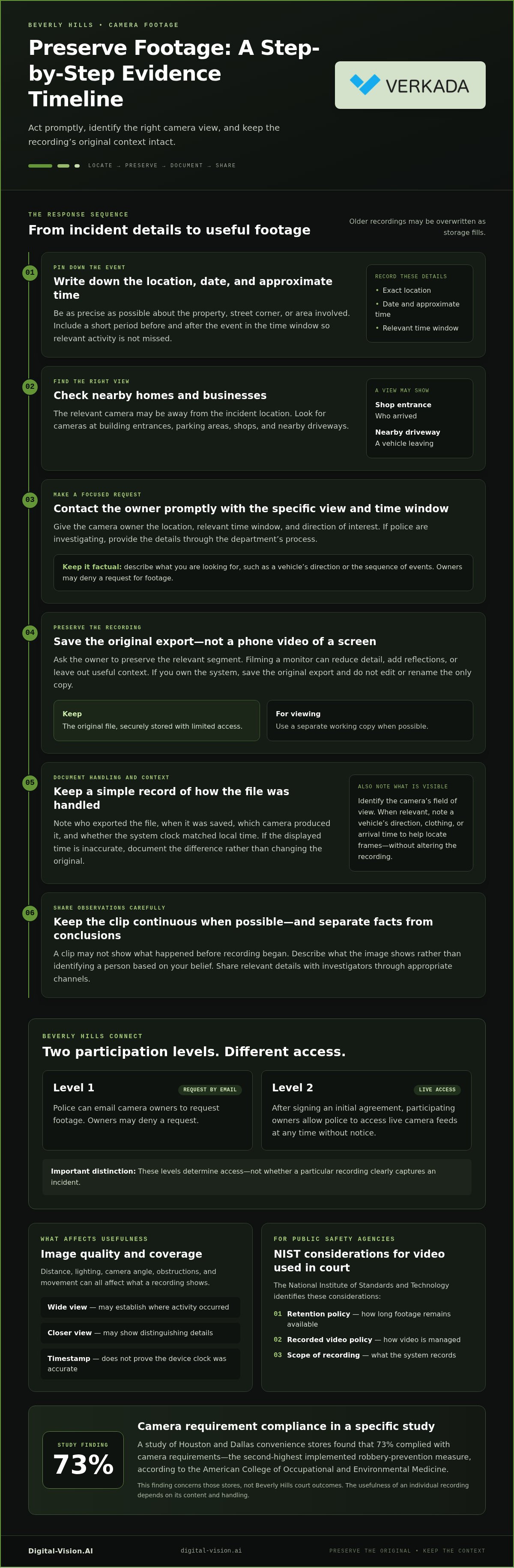
If a camera may have captured an incident, act promptly: recordings can be overwritten, and the relevant view may come from a nearby home or business rather than the incident location. A clear, preserved recording can provide useful context, but its value depends on what it shows and how it is handled.
This guide explains how to seek footage in Beverly Hills, what to do with a recording, and which details can affect its usefulness as evidence. You’ll also learn how access through Beverly Hills Connect differs by level, and why preserving the original file, noting relevant details, and sharing it through appropriate channels can help keep the material useful for review.
Table of Contents
Security camera footage for evidence Beverly Hills
Security footage can help investigators establish where and when an event occurred and what followed. In Beverly Hills, police upload camera footage to a server after a crime and check it for suspects. A recording may also clarify details witnesses remember differently, such as a vehicle’s direction or the sequence of events.
Access depends on how a camera participates in Beverly Hills Connect. Level 1 allows the Beverly Hills Police Department to contact camera owners by email and request footage. Owners may deny a request. Level 2 works differently: after signing an initial agreement, participating owners allow police to access live camera feeds at any time without notice. These levels determine access, not whether a particular recording clearly captures an incident.
If you’re seeking footage after an incident, start with a precise location and time window. Identify the property or street corner, the approximate event time, and camera views that might cover it. A shop entrance may show who arrived, while a nearby driveway camera could capture a vehicle leaving. Include a short period before and after the event so you don’t miss relevant activity.
Write down the exact location, date, and approximate time of the incident.
Note visible camera locations nearby, including building entrances and parking areas.
Contact the camera owner promptly and describe the specific view and time window.
If police are investigating, provide the details through the department’s process.
Act promptly because camera systems may record over older files as storage fills. Ask the owner to preserve the relevant segment instead of relying on a phone recording of a monitor. Filming a screen can reduce detail, add reflections, or leave out useful context. If you own the system, save the original export and avoid editing or renaming the only copy.
Keep a simple record of how the file was handled. Note who exported it, when it was saved, which camera produced it, and whether the system clock matched local time. If the displayed time is inaccurate, document the difference rather than changing the original. Keep a separate working copy for viewing, and store the original securely with limited access.
Useful footage needs context as well as a visible event. A clip showing someone near a vehicle, for example, may not establish what happened before recording began. Preserve a continuous segment when possible, and identify the camera’s field of view. Noting a vehicle’s direction, clothing, or arrival time can help investigators locate relevant frames without altering the recording.
Video quality depends on distance, lighting, camera angle, obstructions, and movement. A wide view may establish where activity occurred, while a closer view may show distinguishing details. Night footage can look different from daytime footage, and a timestamp alone doesn’t prove the device’s clock was accurate. Separate observations from conclusions: describe what the image shows, not who you believe a person is.
Evidence handling matters for public safety agencies, too. The National Institute of Standards and Technology identifies a retention policy, a recorded video policy, and a scope of recording as considerations for using video in court. These practices help establish what a system records, how long footage remains available, and how video is managed. They don’t replace careful preservation of the specific clip.
A study of Houston and Dallas convenience stores found that 73% complied with camera requirements, the second-highest implemented robbery-prevention measure, according to the American College of Occupational and Environmental Medicine. That finding concerns those stores, not Beverly Hills court outcomes. It illustrates why cameras may form one part of a security approach, while an individual recording’s usefulness depends on its content and handling.
For an incident in Beverly Hills, keep your request factual and focused: give the camera owner the location, time window, and direction of interest. Preserve any recording you control, and share relevant details with investigators. Nearby cameras may offer another view, but access and image clarity vary by camera and program level.
Beyond official reporting, some business owners also circulate relevant community updates or public notices online. For organizations seeking to build broader visibility and engagement across platforms such as Instagram or YouTube, Greedier Social Media offers paid engagement growth services.
Digital-Vision.AI: Video Surveillance Systems
Digital-Vision.AI helps property owners plan Video Surveillance Systems for purposeful camera coverage. If you’re reviewing blind spots, replacing outdated cameras, or planning an installation, high-definition cameras with intelligent analytics can help capture activity across key areas. Placement, lighting, viewing angles, and storage settings all influence how useful footage may be later.
For a broader security plan, Digital-Vision.AI can coordinate video surveillance with Alarm Services, Access Control Solutions, and Integration Services. Consulting can help align system design with a property’s layout and security priorities, whether residential or commercial. These systems support security operations, but they don’t determine whether footage will be accepted as evidence in a particular case.
Contact Digital-Vision.AI to discuss a video surveillance system for your property.
Plan for What Comes Next
An incident can prompt a broader review of how a property’s security systems work together. For substantial private estates and wealth managers such as the Vieyra Family Office, structured security protocols and meticulous documentation are integral to safeguarding assets. Consider which entrances, shared spaces, and activity areas matter most, then align camera coverage with the property’s daily routines. A thoughtful plan considers sightlines, lighting, entry procedures, and how staff use the space, rather than treating each camera as a separate device.
For property owners considering security camera footage for evidence in Beverly Hills, a review can also show where surveillance should connect with wider security priorities. Digital-Vision.AI offers Video Surveillance Systems, Alarm Services, and Access Control Solutions. Coordinating these elements can support a clear approach to monitoring, alerts, and entry management, tailored to the property’s layout and operational needs. This provides a practical basis for future decisions, whether you’re refining existing coverage or planning a new system.
Contact Digital-Vision.AI to discuss your property’s security needs and determine a sensible next step. A well-considered plan starts with the priorities that matter most to you.
Comments