


License Plate Recognition Cameras in Beverly Hills: A 2026 Guide
Updated: 2 minutes ago
What if a camera overlooks your Beverly Hills entrance but still can’t capture a readable license plate? With license plate recognition cameras Beverly Hills property owners need more than a camera pointed at the driveway. Camera placement, viewing angle, distance, lighting, and the way vehicles approach all affect whether footage can support plate recognition.
It’s also worth asking how this technology differs from ordinary video surveillance and who can access the information it captures. License plate recognition uses video analytics to identify plate details, while standard surveillance primarily records images for later viewing. Each has a distinct role, and both call for thoughtful planning around privacy and system access.
This 2026 guide explains how license plate recognition works, what can affect its performance, and what to consider when planning an installation at a Beverly Hills property. You’ll learn how camera positioning and site conditions shape coverage, why clear data governance matters, and how recognition cameras can fit into a wider security plan. The goal is practical expectations and responsible safeguards for properties in Beverly Hills, Orange County, and Irvine.
Table of Contents
What License Plate Recognition Cameras Do at Beverly Hills Properties
What Affects License Plate Recognition Camera Performance in Beverly Hills
License Plate Recognition vs. Standard Security Cameras: Privacy and System Trade-Offs
How to Plan a License Plate Recognition Camera Installation in Beverly Hills
A Professionally Designed License Plate Recognition Camera System in Beverly Hills
What License Plate Recognition Cameras Do at Beverly Hills Properties
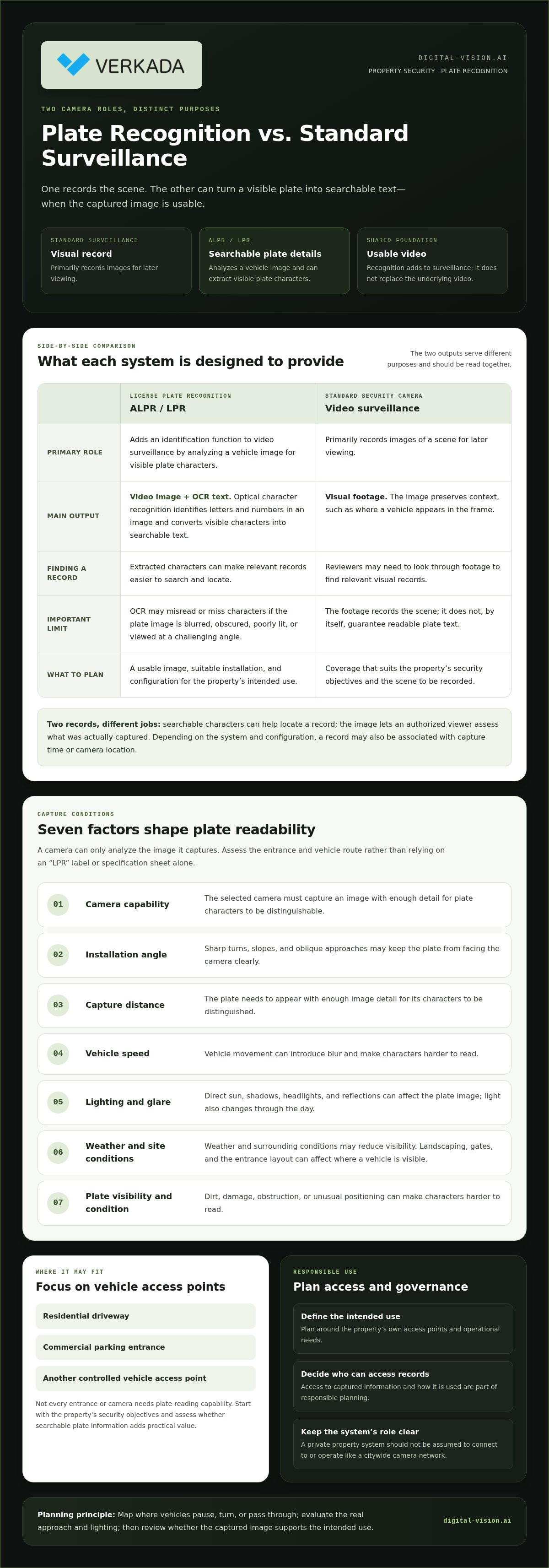
License plate recognition adds an identification function to video surveillance. Instead of requiring someone to review footage frame by frame, the system can analyze a vehicle image and extract characters from a visible plate. That can make relevant records easier to find, but it doesn’t replace the underlying video or guarantee that every passing plate will be readable.
For license plate recognition cameras Beverly Hills property owners, the key distinction is between recording a scene and converting plate characters into searchable information. The latter depends on a usable image and system capabilities configured for the property.
How ALPR cameras interpret a passing vehicle
Automatic license plate recognition (ALPR) is a video-based process that captures an image of a vehicle’s license plate and uses optical character recognition to convert visible characters into text that can be searched. Optical character recognition, or OCR, is software that identifies letters and numbers in an image. An overview of Automatic number-plate recognition (ANPR) technology explains the broader process and its uses.
The camera image and extracted text serve different purposes. Video preserves visual context, such as the vehicle’s position in the frame. OCR creates a text record that may be easier to search. Depending on the system and its configuration, a record may also be associated with details such as capture time or camera location. These elements are not interchangeable: extracted characters can help locate a record, while the image lets an authorized viewer assess what was actually captured.
OCR can misread or miss characters when a plate image is blurred, obscured, poorly lit, or viewed at a challenging angle. A system’s label alone doesn’t establish what it can capture at a particular entrance. Image quality, installation, and configuration all matter, so design should start with the vehicle approach and the intended use of the records.
Where Beverly Hills properties may use plate recognition
Possible private-property applications include a residential driveway, a parking entrance at a commercial site, or another controlled vehicle access point. The aim might be to make relevant vehicle footage easier to locate during a review. That doesn’t mean every entrance or camera needs plate-reading capability. Start with the property’s security objectives and decide whether searchable plate information adds practical value.
Private systems also differ in purpose and governance from public agency camera networks. A property owner’s system is planned around its own access points and operational needs. It shouldn’t be assumed to connect to or operate like a citywide network. Decisions about who can access records and how they are used are part of responsible planning.
For a broader look at aligning surveillance with the layout and needs of a Beverly Hills residence, see the Beverly Hills AI security camera installation guide. Considering plate recognition alongside overall camera coverage helps keep the plan focused on the entrances and security goals that matter.
What Affects License Plate Recognition Camera Performance in Beverly Hills
A plate-reading system can only analyze the image it captures. The camera, its position, vehicle movement, and changing site conditions all influence whether the plate appears clear enough for recognition. Plate readability depends on camera capability, installation angle, capture distance, vehicle speed, lighting, weather, and the plate’s visibility and condition.
That’s why a specification sheet or “LPR” label can’t predict results at a particular property. A Beverly Hills estate driveway may have a curved approach, landscaping, or a gate that affects where a vehicle is visible. A commercial parking entrance in Orange County or Irvine may have several lanes or vehicles entering close together. Each layout creates different capture considerations.
Placement, approach angle, distance, and vehicle speed
Plan the vehicle route and camera position together. If cars turn sharply, approach on a slope, or pass the capture area at an oblique angle, the plate may not face the camera clearly. Distance matters too: the image needs enough detail for characters to be distinguishable, and movement can introduce blur.
Assess the actual driveway or parking entrance before finalizing placement. Identify where vehicles pause, turn, or pass through, then check whether the view covers the intended capture area without including unnecessary surrounding activity. Equipment and site conditions inform the final design. A location that looks suitable on a plan may need adjustment after the actual approach is evaluated.
Lighting, glare, weather, and plate variation
Light changes throughout the day. Direct sun, shadows, headlights, and reflections from nearby surfaces may affect the plate image. Weather and other environmental conditions can also reduce visibility. Account for the entrance’s surroundings rather than assuming one lighting condition represents every capture.
Plates vary in appearance and condition. Dirt, damage, obstruction, or unusual positioning can make characters harder to read. No system should be treated as certain to recognize every plate. Performance expectations depend on the selected equipment and an assessment of the property, including its approach, lighting, and intended capture area.
For a useful assessment, map each vehicle path and identify the point where the plate should be captured. Evaluate sightlines, lighting changes, and vehicle movement through that area. After installation, review recorded images under relevant site conditions. This helps assess the system against its intended purpose instead of relying on assumptions about theoretical performance.
Thoughtful design aligns camera placement with the property and its operational goals. A professional security assessment can help evaluate entrance coverage and how surveillance fits alongside other security components.
License Plate Recognition vs. Standard Security Cameras: Privacy and System Trade-Offs
Both camera types can contribute to a security plan, but they serve different purposes. General surveillance records scenes for later viewing, while plate recognition adds a way to search text extracted from visible license plates. That search function can be useful at a vehicle entrance, but it also creates decisions about who can access records and how long they are kept.
Plate recognition isn’t automatically necessary for every camera system. For license plate recognition cameras Beverly Hills property owners should start with a practical question: would searchable plate information help meet a specific security objective, or would ordinary video coverage be sufficient?
When plate recognition adds value beyond general surveillance
The comparison below can help clarify which approach fits a particular location. Actual capabilities depend on the selected system and its configuration.
General video surveillancePrimary purpose: Record activity across an area for later visual review.Possible scenario: Monitoring a lobby, courtyard, or broad parking area where visual context matters more than searching plate characters.
Plate recognitionPrimary purpose: Extract visible plate characters so records may be searchable by that text.Possible scenario: Reviewing vehicle activity at a driveway or parking entrance where locating a particular plate record could support an operational need.
Combined coveragePrimary purpose: Address distinct coverage goals through a planned surveillance design.Possible scenario: A property may use general video in shared areas and consider plate recognition at a defined vehicle access point, depending on its objectives and system capabilities.
Searchable plate text changes how records can be found; it doesn’t replace visual footage or establish what happened by itself. Don’t assume all cameras share analytics, databases, or access controls. Those capabilities depend on the system selected and how it is configured.
Privacy, access, and retention questions for Beverly Hills owners
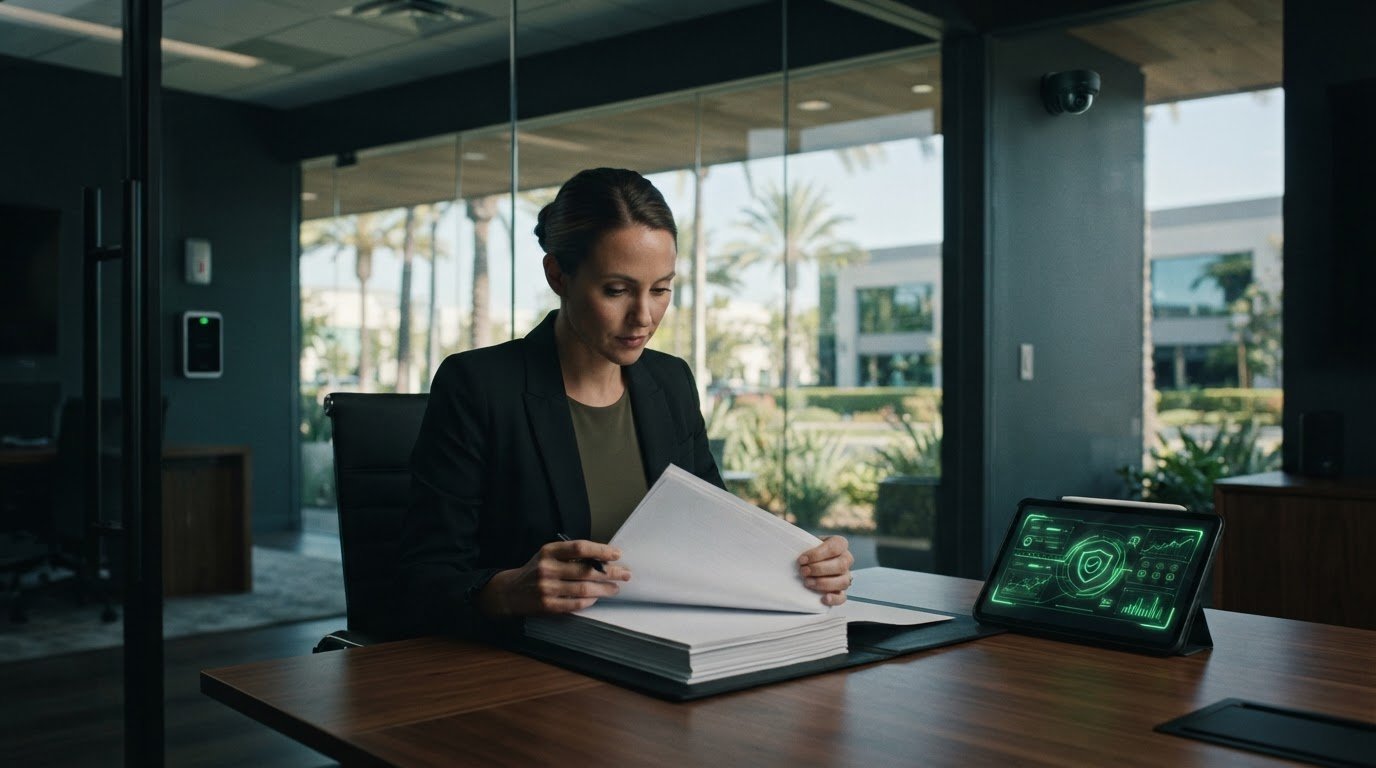
Address privacy through deliberate system governance, not alarmist assumptions or a promise of risk-free operation. Before deployment, document why plate information is collected and establish clear boundaries for its use. A simple written framework can help make day-to-day practices consistent:
Purpose: State the security or operational objective the system is intended to support.
Authorized access: Identify who may view or search records and the reasons access is allowed.
Retention: Set a documented retention period suited to the stated purpose, then define how the policy is applied.
Review responsibility: Assign responsibility for reviewing access practices and keeping procedures current.
These decisions support accountability and help property stakeholders understand how the system is intended to operate. Consider them alongside camera placement, access control, and other security components, so governance reflects the complete system rather than a single device.
Legal and policy obligations can depend on the system and its use. For current guidance, consult official California and City of Beverly Hills sources rather than relying on general summaries. A clear, documented approach helps owners weigh the trade-offs and decide whether searchable plate data is justified for their property.
How to Plan a License Plate Recognition Camera Installation in Beverly Hills
A well-planned installation starts with the security objective, not a camera model. For license plate recognition cameras Beverly Hills property owners should consider how vehicles move through the site, what the system needs to help residents or staff do, and how records will be managed. A private driveway, estate entrance, commercial parking area, and controlled access point each call for a design shaped around their layout and use.
Assess the entrance, use case, and capture zone
Map vehicle entry and exit routes and identify the area where plate capture is intended. Note whether vehicles turn, queue, pause at a gate, or approach from more than one direction. Document practical site constraints too, including suitable mounting surfaces, changing light, available power, and network connectivity. An on-site assessment helps translate these details into a realistic plan.
Design, install, test, and review the system
Use the assessment to shape the camera layout and wider system plan. Design should reflect the property’s security objective and account for how video records will be stored, accessed, and reviewed. After installation and configuration, test under representative conditions to assess whether the setup supports its intended purpose.
Define the objective. Decide whether the priority is locating vehicle footage during an incident, supporting an access workflow, or meeting another specific security need. This helps determine whether plate recognition adds value at a particular entrance.
Assess the site. Map vehicle routes, capture areas, mounting options, lighting, and physical constraints. Consider how a commercial parking entrance differs from a single estate driveway or controlled entry lane.
Plan system requirements. Consider power, network connectivity, recording, storage, authorized access, and retention. For facilities requiring advanced network infrastructure, engineering consultancies like AVC Principles can assist with overarching ICT and system design. If coordination with access control or other security components is a goal, define what information or actions need to connect, then plan around the selected system’s capabilities.
Design and install. Translate site findings into a camera and system layout, followed by professional installation and configuration. A broader unified security ecosystem installation guide can help frame how surveillance may fit alongside other components.
Test and review. Evaluate the installed setup under representative operating conditions. Review image records, access procedures, and retention practices after deployment, and revisit them if the property’s operations or security objectives change.
This sequence provides a structured way to move from a defined need to a considered installation without assuming every technical option is necessary. Digital-Vision.AI designs and installs integrated security systems. A free security assessment can help identify site goals, coverage needs, and integration priorities for properties in Beverly Hills, Orange County, and Irvine.
A Professionally Designed License Plate Recognition Camera System in Beverly Hills
Planning license plate recognition cameras Beverly Hills properties can involve more than selecting a camera. Entrance layout, security priorities, desired coverage, and the approach to managing recorded information all shape the system design. Digital-Vision.AI is based in Beverly Hills and designs and installs integrated security systems for residential and commercial properties, connecting camera planning with the needs of the site.
From property assessment to integrated installation
A free security assessment provides a practical starting point. It can help identify the property’s goals, the vehicle areas that need coverage, and priorities for coordinating surveillance with other security components. A long estate driveway presents different layout considerations from a commercial parking entrance or controlled access point. Design should reflect those differences rather than apply a one-size-fits-all layout.
After assessing the site, Digital-Vision.AI develops a tailored system design and carries out physical installation for surveillance, alarms, and access control. The plan can bring these components together where they fit the property’s goals. Because each serves a different role, integration planning should account for the selected system’s capabilities and how people at the property will use it. For properties where vehicle entry is part of a broader access plan, an access control system installation guide offers useful context on coordinating security and entry management.
System configuration is another part of the process. Digital-Vision.AI configures AI analytics and integrates security components, tailoring the design to the project rather than assuming a particular camera’s performance. Installation planning can also address how footage and other records will be handled, who needs access for operational purposes, and how the system fits the property’s established procedures.
Ongoing system support and next steps
Security needs can evolve as a property’s operations change. Maintenance, technical support, and consulting help owners manage their systems over time and keep configuration and procedures aligned with current needs. Reviewing coverage and system use after installation can help identify when a change in the property or its operating priorities calls for a fresh look at the design.
A professionally planned system brings the discussion back to practical questions: which areas matter, what the technology is intended to support, and how the different security components should work together. A site-specific assessment establishes those priorities before design and installation, while keeping expectations grounded in the property and selected equipment.
Request a free security assessment to discuss your property’s goals, camera coverage needs, and integration priorities with Digital-Vision.AI.
Make Your Next Security Decision With Confidence
Turn your interest in license plate recognition cameras Beverly Hills into a clear decision about your property. Before adding technology, define what you want the system to help you do and who will be responsible for using the information it produces. A focused plan gives property stakeholders a shared basis for weighing coverage, access, and ongoing oversight.
That planning can also make future changes more deliberate. If the property’s operations shift, revisit the original purpose and decide whether the system still supports it. Thoughtful security design isn’t only about installing equipment; it’s about creating an approach aligned with the people and place it serves.
Digital-Vision.AI can help translate those priorities into a tailored security plan for properties in Beverly Hills, Orange County, and Irvine. Arrange a free security assessment to explore the right next step for your property.
Frequently Asked Questions
Can license plate recognition cameras read plates on moving vehicles?
Yes, they can be designed to capture plates on moving vehicles, but readable results depend on the camera setup and conditions at the capture point. A vehicle turning into a driveway, moving quickly through a parking entrance, or passing behind another car may produce a less useful image. During planning, consider the route vehicles take and how quickly they pass the intended capture area. Test the installed system with the site’s typical traffic flow.
Does a license plate recognition camera identify the driver?
No. Plate recognition extracts characters from a plate; it doesn’t establish who was driving or identify a person. A separate video image may show some occupants, depending on the camera’s view, but that image may not clearly show the driver. Treat a plate record as vehicle-related information, not proof of a person’s identity. If an incident requires identifying someone, review relevant footage in context rather than relying on extracted plate text alone.
Can license plate recognition cameras read temporary or specialty plates?
Sometimes, but recognition can vary with the plate’s design, condition, placement, and visibility, as well as the system’s capabilities. A temporary plate displayed inside a window, for example, may be harder to capture than a clearly visible plate mounted in its usual position. Specialty designs can also present different visual patterns for recognition software. Don’t assume every plate format will be read consistently; assess the intended use and equipment in the context of the property.
How long should license plate recognition data be retained?
There isn’t one retention period that suits every property or purpose. Set a documented period based on why the data is collected, how it will be used, and who is responsible for reviewing it. Avoid keeping records indefinitely by default. Before setting or changing a policy, consult current official California and City of Beverly Hills sources for guidance relevant to your system and use. Make the policy accessible to the people responsible for system oversight.
Is license plate recognition the same as a red-light camera?
No. License plate recognition captures and interprets visible plate characters; by itself, it doesn’t determine that a traffic violation occurred. A red-light camera system is associated with monitoring traffic at a signal for potential red-light violations. The two may involve vehicle images, but their purpose and operating context differ. A private property system should be planned around its specific security objective, rather than treated as a traffic enforcement system.
Can license plate recognition cameras be integrated with access control?
They may be incorporated into a broader security design that includes access control, but the available interaction depends on the selected equipment and configuration. For example, a property might want vehicle records considered alongside a controlled entry process, without assuming plate recognition automatically opens a gate or validates authorization. Define the intended workflow first. Digital-Vision.AI designs integrated systems for properties in Beverly Hills, Orange County, and Irvine, with planning tailored to site needs.
Do license plate recognition cameras work at night?
They can capture plates at night if the equipment and installation are suited to the location’s lighting conditions, but nighttime results aren’t automatic. Headlights, reflections, shadows, and low ambient light can affect the image. A camera position that performs well in daylight may need a separate review after dark. Evaluate sample footage during representative nighttime conditions, especially at entrances used after sunset, and align expectations with the selected equipment and site assessment.
Comments