


Orange County Business Security Assessment: A Practical 2026 Guide
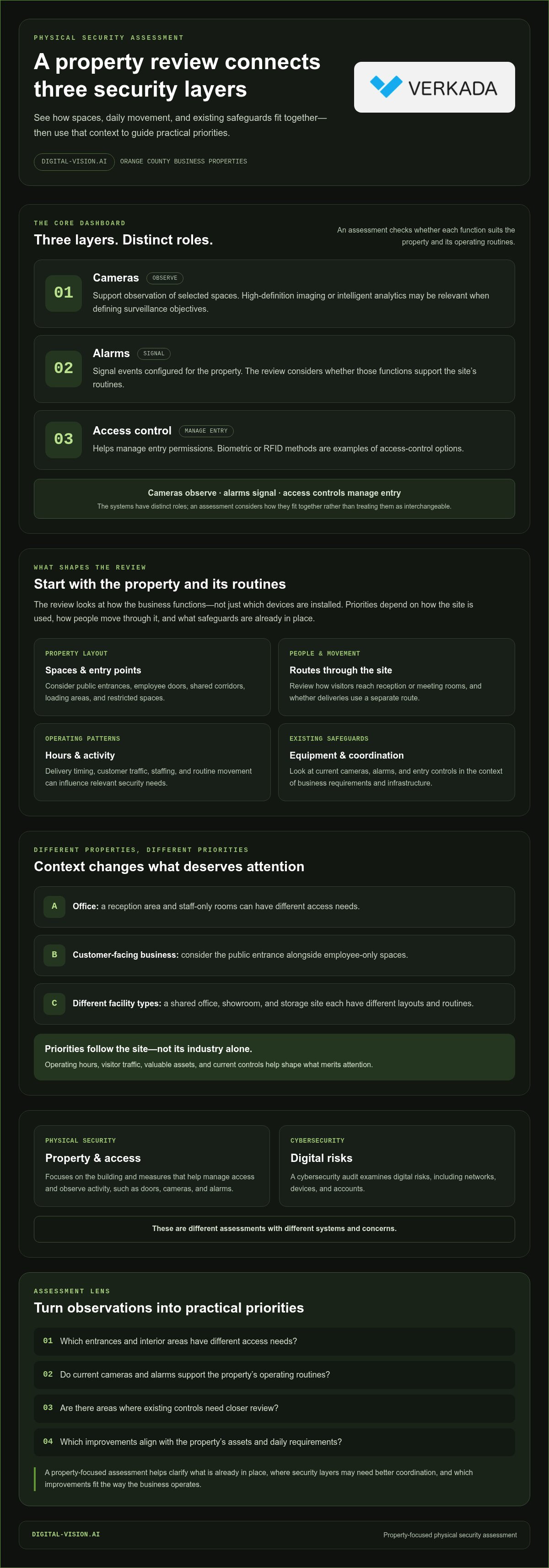
What if your cameras, alarms, and entry controls all work as designed, yet still leave gaps because they operate separately? An Orange County business security assessment looks beyond individual devices to examine how each layer supports the property as a whole.
It can be hard to tell where coverage falls short or which improvements deserve attention first. A practical assessment reviews existing security infrastructure in the context of your property and its operations. That helps identify where cameras, alarms, and access controls may need to work together more effectively.
This guide explains what a physical security assessment can cover, how to prepare, and how to use its findings to plan a coordinated approach. You’ll learn how to identify practical priorities for your site and consider integrated security solutions. Digital-Vision.AI provides tailored assessments and recommendations for Orange County businesses, giving you a clear starting point for security planning.
Table of Contents
What an Orange County Business Security Assessment Covers
An Orange County business security assessment is a structured review of a property’s physical security needs. It considers how the building is used, how people move through it, and how existing safeguards support daily operations. The goal is to understand how spaces, entry points, surveillance, and alarms function together, then use that information to guide practical decisions.
Priorities depend on the property. An office with a reception area and staff-only rooms has different access needs from a customer-facing business with a public entrance and employee-only spaces. Operating hours, visitor traffic, valuable assets, and current controls also shape what deserves attention. An assessment should reflect these conditions rather than apply the same checklist to every site in Orange County, Beverly Hills, or Irvine.
Physical security assessment versus cybersecurity audit
Physical security focuses on the property and measures that help manage access and observe activity, such as buildings, doors, cameras, and alarms. A cybersecurity audit examines digital risks, including networks, devices, and accounts. The terms may overlap in everyday conversation, but the assessments address different systems and concerns. This guide focuses on physical security for business properties.
Which Orange County businesses may benefit?
Offices, commercial properties, and businesses with controlled or customer-facing areas can benefit from a clearer view of their physical security. An office with a public reception space, for example, may need to consider how visitors reach employee-only areas. Irvine businesses with different types of facilities may also need location-specific priorities: a shared office, showroom, and storage site each have different layouts and routines.
What matters is how a particular property operates, not simply its industry. A useful review considers how people, spaces, and existing controls fit together. For example, a camera may cover an entrance while an access control measure determines who can pass through it. Reviewing both helps clarify how the layers contribute to the site’s overall approach.
Assessment findings should help decision-makers choose sensible next steps, not create fear or suggest that any system can guarantee prevention. A tailored review of existing security infrastructure can turn concerns into practical questions:
Which entrances and interior areas have different access needs?
Do current cameras and alarms support the property’s operating routines?
Are there parts of the site where existing controls need closer review?
Which improvements align with the property’s assets and daily requirements?
Digital-Vision.AI provides security assessments and consulting for commercial properties, with recommendations tailored to the site’s risks and existing infrastructure. This property-focused review helps businesses in Orange County understand what is already in place, where security layers may need better coordination, and which improvements fit how the business operates.
How a Business Security Assessment Examines Your Property
A property-focused review looks at how a business functions, not just which devices are installed. An Orange County business security assessment considers the site’s layout, how people move through it, and whether existing equipment supports business routines. The objective is to connect observations with practical surveillance, alarm, and access-control needs, while tailoring recommendations to the property.
Reviewing property exposure, movement, and operations
Start with the routes people use: public entrances, employee doors, shared corridors, loading areas, and spaces with restricted access. Consider how visitors reach reception or meeting rooms, and whether deliveries use a separate route. CISA’s Physical Security Guidance offers a useful reference for considering physical protection in relation to a site’s layout and operations.
Operating patterns add essential context. A business that receives deliveries before opening may have different access needs from a site that welcomes customers throughout the day. Staffing levels, routine movement between areas, and operational constraints can influence where surveillance, alarms, or entry controls may be relevant. These are examples to consider, not assumptions about any particular business in Orange County.
Assessing cameras, alarms, and access control together
Each system has a distinct role. Cameras support observation of selected spaces. High-definition imaging or intelligent analytics may be relevant when defining surveillance objectives. Alarms signal events configured for the property. Access control, including biometric or RFID methods, helps manage entry permissions. An assessment considers whether these functions suit the site and its routines rather than treating the equipment as interchangeable.
Coordination matters because a property may need to observe activity, manage entry, and respond to alarm events as connected parts of its security approach. Integration can help components work as an ecosystem. The assessment considers how existing infrastructure and business requirements should inform that planning, without assuming every site needs the same technology or configuration.
Cameras help observe, alarms help signal, and access controls help manage who can enter. An assessment considers how each layer fits the property’s needs.
For example, a business might use a public entrance, a staff-only workspace, and a delivery door. Reviewing these areas together can clarify whether each needs the same kind of coverage or distinct controls. It can also surface practical questions, such as how authorized staff move between spaces and how deliveries are handled without disrupting normal work.
Digital-Vision.AI provides security assessments tailored to existing infrastructure and site-specific needs. To consider how cameras, alarms, and access control can work together at your property, explore Digital-Vision.AI security assessment services.
How to Prioritize Business Security Findings in Orange County
An assessment is most useful when it helps decision-makers distinguish practical concerns from longer-term system choices. For each finding, consider the property’s layout, who uses the area, what happens there, and how existing controls support that activity. This keeps priorities tied to business operations instead of an arbitrary score or a universal equipment list.
Compare needs across surveillance, alarms, and entry control
Start by identifying the function behind each finding. Surveillance relates to visibility, alarms to signaling events, and access control to managing entry. A customer-facing office may focus on observing public and staff areas, while a site with restricted workspaces may give more attention to entry permissions. The right planning step depends on the business’s requirements, not its location alone.
Recognize when disconnected systems create planning gaps
Separate components can serve their individual purposes while leaving staff without a clear view of how they relate. An Orange County business security assessment can surface coordination questions, such as whether camera coverage, alarm use, and controlled entry reflect the same operating priorities. Integration is one planning option, not an automatic requirement. A business with straightforward needs may prioritize a different approach from a site with varied spaces and routines.
Security priorities depend on a property’s needs and operations, not on a universal list of equipment.
Keep planning grounded by separating immediate operational questions from longer-term design decisions. Immediate questions might include who uses a particular entrance or how a current system fits routine activity. Longer-term choices may involve whether existing components should be updated, coordinated, or retained. Rather than assigning unsupported numerical scores, record the condition, why it matters to the business, and what decision would clarify the next step.
For businesses considering how separate components might function together, the unified security ecosystem installation guide offers related planning context. Use the findings to frame a focused discussion around visibility, signaling, and entry needs, then weigh each option against the property’s operating requirements.
How to Prepare for an Orange County Business Security Assessment
Preparation doesn’t require technical expertise or special software. A little context about the property helps make an Orange County business security assessment more focused and ensures the review accounts for how the site operates. Orange County locations vary in layout, access, and daily activity, so share your property’s specific concerns rather than relying on assumptions about local risks.
Use this simple sequence to prepare:
Define your concerns. Note what prompted the review, such as uncertainty about visibility in a particular area, questions about who can enter a space, or confusion about how existing systems are used.
Gather available information. Collect materials you already have, such as a floor plan, a list of entrances, or basic details about cameras, alarms, and access controls. You can still proceed if some information isn’t available.
Identify stakeholders. Include people familiar with property access, daily routines, deliveries, and the practical use of existing security systems.
Discuss priorities. Explain which needs matter most, whether that’s visibility, controlled entry, alarm planning, or better coordination between systems.
Information to gather before the review
Start with what’s easy to locate. A floor plan can help describe the site, and a simple list of entrances and restricted areas adds useful context. If you know the types and locations of existing equipment, note them. Include issues such as a camera that doesn’t cover an area of interest or uncertainty about alarm procedures. Everyday-language observations are enough to begin a useful conversation.
Available floor plans and a basic description of entrances and restricted spaces
Known cameras, alarms, and access-control equipment
Operational concerns, including delivery routines or areas with changing access needs
People who understand how staff and visitors use the property and its systems
If alarm planning is one of your priorities, the commercial alarm system installation checklist can help organize questions about that part of your security setup.
Planning the review around business operations
Consider how a review can fit the property’s normal activity and provide appropriate access to relevant areas. Identify spaces that are restricted, sensitive to disruption, or used differently at certain times. This keeps the discussion grounded in actual operations. For example, explain how deliveries are handled or which staff members manage access instead of trying to translate those routines into technical specifications.
Digital-Vision.AI provides free security assessments for commercial properties, with guidance tailored to existing infrastructure and site needs. When you’re ready to discuss your property and priorities, request a free security assessment.
Turn Assessment Findings into a Tailored Security Plan
Assessment findings become useful when they connect observed conditions to decisions a business can act on. Recommendations should reflect the property’s layout, operating needs, and existing security infrastructure rather than assume every site needs the same equipment. For Orange County businesses, a tailored plan can clarify which concerns relate to surveillance, alarms, access control, or how those components work together.
From assessment priorities to coordinated systems
Findings can inform choices about what the property needs to observe, where alarms fit into operations, and how access to specific areas is managed. Video surveillance may support visibility objectives, with intelligent analytics considered where relevant. Alarm services and access control serve distinct purposes, while integration can help align components with identified site needs. The right combination depends on the assessment, not on a requirement to adopt every technology.
For example, if a business identifies a need to review visibility in a particular area, planning can focus on whether its current surveillance approach serves that purpose. If the concern involves entry permissions, access-control planning may be more relevant. Where separately managed systems complicate coordination, integration can be considered. Each choice should address a finding rather than add complexity without a clear purpose.
Surveillance requirements depend on the property and its coverage goals. For context on camera planning, the AI security camera installation guide explores surveillance-specific considerations. Findings may also inform decisions about alarms, access control, integration, and ongoing maintenance and support, helping businesses weigh current needs alongside the systems already in place.
To carry findings into planning, keep each recommendation tied to a clear business need:
Connect each observation to the area, routine, or access need it concerns.
Consider whether an existing system addresses that need or calls for further review.
Distinguish priorities for current operations from longer-term system-design decisions.
Consider how proposed components could work together without assuming integration is necessary everywhere.
This approach keeps the plan focused. Installing or changing equipment does not eliminate risk. Instead, a tailored plan supports informed decisions about the property’s security layers and their intended roles.
Request a tailored security assessment
Digital-Vision.AI provides free security assessments for residential and commercial properties. For a business, the assessment is a practical starting point for guidance tailored to its risks and existing infrastructure. It can bring property-specific concerns into focus and inform next steps across surveillance, alarms, access control, integration, and support.
Ready to put your property’s needs into a clearer plan? Request your free business security assessment.
Make Your Next Security Decision with Confidence
A security plan should reflect how your business operates. As spaces, routines, or access needs change, revisit whether your current approach still supports those priorities. You don’t need to begin with a major system overhaul. Start with one question your Orange County business security assessment brought into focus, then consider the next practical step for your property.
Digital-Vision.AI offers free security assessments for residential and commercial clients, with guidance shaped around existing infrastructure and specific risks. That gives your business a practical way to move from questions to informed planning without assuming every property needs the same solution.
Take the first step with a free assessment and give your property’s security planning a clear, tailored starting point.
Frequently Asked Questions
Is a business security assessment the same as a cybersecurity audit?
No. A physical assessment considers the property itself, including building areas, entry points, cameras, alarms, and access controls. A cybersecurity audit focuses on digital environments, including networks, accounts, and devices. Some businesses may need both reviews, but they answer different questions. This Orange County business security assessment guide covers physical security, so concerns about digital systems fall outside its scope.
How often should a business have its physical security assessed?
There’s no single review interval that fits every property. Consider a fresh assessment after a move, renovation, change in how a room is used, or shift in visitor or staff access patterns. For example, converting an office area into a customer meeting space may change how people move through the building. Questions about how existing equipment fits daily operations can also be a reason to revisit priorities.
How long does a business security assessment take?
The time depends on the property, its operations, the areas involved, and the questions the business wants addressed. A compact office with a straightforward layout may call for a different review from a facility with multiple buildings or restricted spaces. To plan around work schedules, identify areas that need review and note any access constraints. Discuss the scope and operational requirements when arranging the assessment rather than relying on a standard duration.
Does a business security assessment include a cybersecurity penetration test?
No. A physical security assessment reviews property-related needs, such as how surveillance, alarms, and access control fit the site. A penetration test evaluates digital systems and belongs to a cybersecurity scope. Keeping those objectives distinct helps a business direct its questions to the right area. For instance, a concern about staff access to a storage room is physical, while a concern about account access is digital.
What should a business do with assessment findings?
Use the findings to decide what needs attention, what to monitor as operations change, and what calls for longer-term planning. A useful next step is to assign someone to each operational question, such as clarifying who manages access to a restricted room. Then compare possible actions with the site’s needs instead of treating every observation as a request to purchase equipment.
Can a security assessment help a business plan an integrated system?
Yes. Reviewing existing infrastructure alongside business priorities can clarify whether cameras, alarms, and access controls should be coordinated. Integration may be worth considering if separate systems make it difficult to manage the property’s security approach, but it isn’t necessary for every site. Digital-Vision.AI provides security consulting and integration services, helping businesses in Beverly Hills, Orange County, and Irvine consider options in relation to their property needs.
Is a free security assessment useful if a business already has cameras and alarms?
Yes. Equipment can be in place while questions remain about whether it still suits the property’s current use. For example, a business may have changed how employees use an area without revisiting the role of existing cameras or alarms. A review can clarify those questions and inform planning across existing systems. Digital-Vision.AI offers free assessments for residential and commercial clients, including businesses in Orange County.

Comments