


Retail Internal Theft: Controls for Orange County Stores
Updated: 5 hours ago
Employee theft accounts for 29% of total U.S. retail shrink in 2026. It includes employees taking cash or merchandise, as well as concealing missing money through actions such as ringing up a lower price than the actual price. For retailers looking at how to prevent internal theft in retail across Orange County, the practical approach is to limit access, improve visibility, review activity and investigate inventory discrepancies.
It’s understandable to want clear answers when cash or stock doesn’t add up, but one discrepancy isn’t proof of theft. This guide explains how retailers can prevent internal theft in Orange County by building consistent controls rather than relying on suspicion. Learn how to secure stockrooms and cash-handling areas, reduce floor-plan blind spots, use video monitoring thoughtfully, and review inventory and transaction patterns. These steps help identify emerging risks and respond with better records and oversight.
Table of Contents
1. What is retail employee theft?
Employee theft is the unauthorized taking, diversion, or concealment of a retailer’s cash, merchandise, or resources. It can include removing products, changing records, or ringing up a lower price than the actual price to conceal cash taken from a till. Employee theft accounts for 29% of total U.S. retail shrink, while external theft is a separate source of inventory loss. The U.S. Chamber of Commerce reports that 75% of employees will steal from an employer during their professional lifetime, a broad statistic that does not establish that any individual employee is likely to steal.
Prevention starts with clear accountability, not suspicion or fear. Where staffing allows, assign different people to reconcile sales, prepare cash deposits, approve refunds, and update inventory records. Set written rules for voids, discounts, returns, and stock adjustments, then review exceptions consistently. Invite employees to suggest practical loss-prevention improvements, explain the purpose of controls, and recognize accurate procedures and timely reporting rather than rewarding accusations or sales outcomes alone. Building positive morale and camaraderie among coworkers—such as organizing casual staff hangouts with a movie night planner app—also helps create an open environment where employees feel valued and invested in store success.
What are the most effective ways to prevent employee theft in retail stores? Combine role-based access, regular inventory checks, transaction reviews, clear procedures, and respectful training. For example, compare a register’s void and refund activity with shift records, then review supporting documentation before reaching a conclusion. A shortage is a reason to investigate processes and records, not proof that a particular employee took merchandise.
How should retailers in Orange County, California, conduct employee bag checks and searches legally? Use a written policy applied consistently that explains when checks occur, what areas or belongings are covered, and how employees will be treated. Give notice, request cooperation, keep checks limited and respectful, avoid physical searches or force, and document refusals or incidents objectively. Apply the same procedure without singling people out based on protected characteristics or personal disputes.
Protect privacy by matching oversight to a legitimate work purpose. Tell staff what transaction records or workplace areas are monitored, limit access to those records, and review only relevant activity. Use consistent criteria, such as an unusual refund pattern or documented inventory discrepancy, rather than assumptions about someone’s appearance, background, or schedule. Keep investigation notes factual and share them only with people responsible for resolving the issue.
What employee training and hiring practices help prevent retail theft? Use detailed applications, contact references and former employers, and train every employee in cash handling, stock procedures, incident reporting, and de-escalation. Include seasonal staff in practical onboarding, such as how to record a suspicious transaction and notify a manager without confrontation. What should staff do when they suspect theft? Document observable facts, preserve relevant records, and alert management instead of confronting or physically stopping anyone.
2. Access control for stockrooms and cash-handling areas
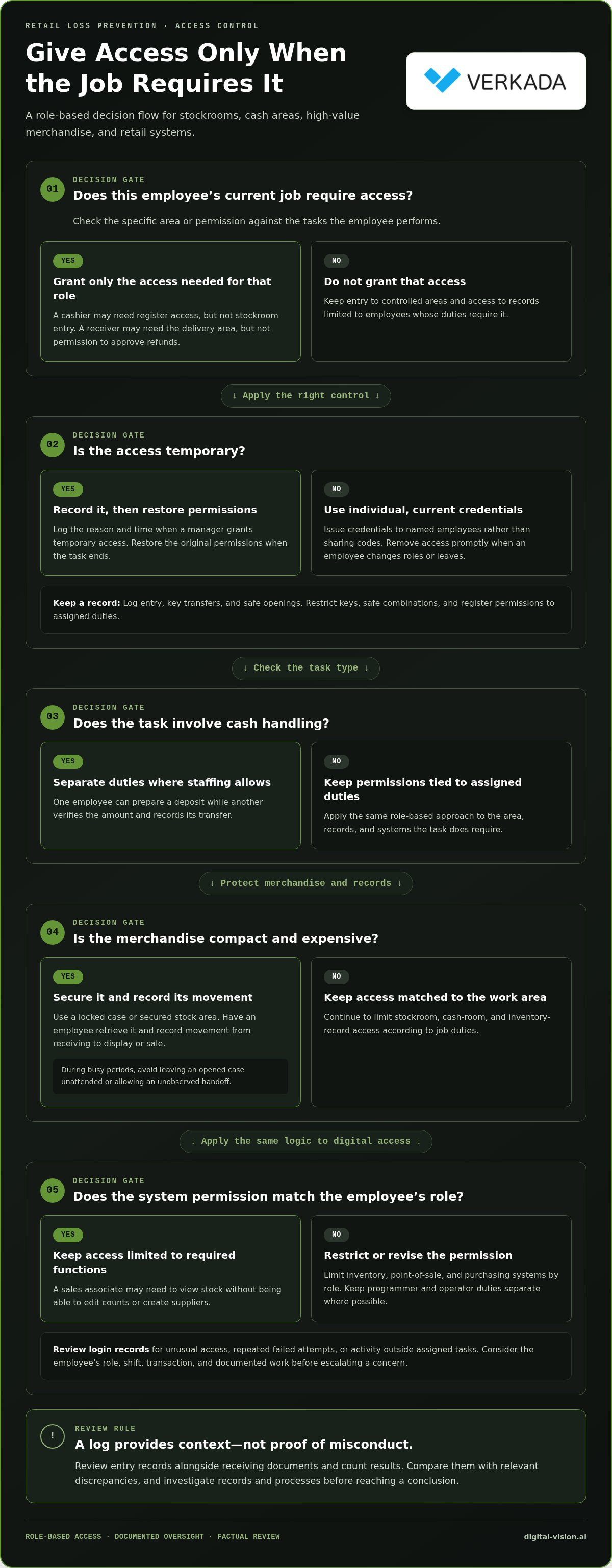
Control entry to stockrooms, cash rooms, and inventory-record areas by assigning access according to job duties. A cashier who needs register access may not need stockroom entry, while a receiver may need access to the delivery area but not permission to approve refunds. Limiting access reduces opportunities for unrecorded movement and clarifies who was authorized to handle merchandise or cash.
Start with an access review for each location. List every controlled area, the tasks performed there, and the roles that require entry. Issue individual credentials rather than shared codes, and remove access promptly when an employee changes roles or leaves. Keep an entry record and review it alongside inventory discrepancies. An access log provides context, but does not prove misconduct on its own.
For cash handling, separate responsibilities where staffing allows. One employee can prepare a deposit while another verifies the amount and records its transfer. Restrict keys, safe combinations, and register permissions to assigned duties. If a manager must grant temporary access, record the reason and time, then restore the original permissions when the task ends.
Match controls for high-value merchandise to the item and its location. Store compact, expensive products in a locked case or secured stock area, and require an employee to retrieve them. Record each item’s movement from receiving to display or sale. During busy periods, avoid leaving an opened case unattended or allowing a distraction to create an unobserved handoff.
Match each credential to a named employee and current role.
Log temporary access, key transfers, and safe openings.
Restrict inventory adjustments and purchasing records to employees who need them.
Review entry records against receiving documents and count results.
Digital permissions matter as much as physical doors. Restrict inventory, point-of-sale, and purchasing systems by role. A sales associate may need to view stock but not edit counts or create suppliers. Keep programmer and operator duties separate where possible, and review login records for unusual access, repeated failed attempts, or activity outside assigned tasks. Before escalating a concern, consider the employee’s role, shift, transaction, and documented work.
Pair access controls with visible surveillance at entrances to restricted areas, while keeping monitoring focused on legitimate security needs. Access Control Solutions can help retailers manage entry permissions, while Video Surveillance Systems can provide visual context for reviewing a documented event. If your stockroom or cash-area controls need a coordinated design, explore retail access control solutions as one part of a broader loss-prevention plan.
3. Store layout and visibility
A clear floor plan helps employees notice when merchandise moves or a display changes. Walk each aisle from the entrance, checkout, and stockroom door. Identify shelves, signs, and seasonal displays that block sightlines, then reposition them so staff can see vulnerable products without leaving their assigned areas. An organized store makes missing items and unusual activity easier to spot.
Place compact, high-value merchandise where staff can readily observe it. A display near the register or beneath a camera is easier to monitor than one beside an exit or behind a tall fixture. For especially valuable items, use a locked case or a shelf that requires employee assistance. Keep access practical so staff can serve customers while maintaining visibility. This is one useful step in how to prevent internal theft in retail Orange County stores.
Use low counters and shelving to reduce blind spots. Keep counters no higher than waist level, and use mirrors to reveal obstructed corners or aisle intersections. Check the view from an employee’s usual position, not just from the store entrance. If a tall promotional stand hides a shelf, move the stand or relocate the merchandise. Repeat the walkthrough after changing displays or adding seasonal fixtures.
Present merchandise consistently so missing items are easier to notice. Arrange small items in neat rows or clear patterns, making gaps stand out during routine work. Keep popular products in a consistent location, and avoid mixing unrelated stock in one display. Retailers considering how to prevent internal theft in retail Orange County can include these quick visual checks in regular floor walks.
Keep sightlines from the register to the entrance and exit clear.
Place small, easy-to-conceal products in visible, well-lit areas.
Move vulnerable merchandise away from secluded corners and exit routes.
Check mirrors and camera views after layout changes.
Checkout placement affects what staff can observe. Where the floor plan allows, position the checkout between merchandise and the store exit, with a clear view of both doors. This makes movement toward an exit easier to notice and keeps staff connected to the sales floor. Avoid displays that create a hidden path between high-value items and an exit.
Visibility is a practical safeguard, not a substitute for fair procedures or attentive service. During a floor walk, note the product, the obstruction, and the staff position from which it cannot be seen. Correct one layout issue at a time, then review the display during a normal shift. This routine helps employees notice inventory changes as they happen.
4. Cameras, remote monitoring, and video analytics
Position cameras to capture work areas where cash, merchandise, and transactions move. Useful views may include registers, receiving doors, stockroom entrances, and high-value displays. Aim to capture activity clearly, not merely a wide view of the room. A camera covering a register should show the transaction area and relevant employee actions without recording private spaces.
Video can support an investigation, but footage needs context. A 2021 study found that 35% of business owners caught employee shoplifters using CCTV alone. Treat recordings as one source of evidence: compare the relevant time and location with register activity, inventory records, and incident notes. AI-assisted video analytics can help flag events for review, but trained people should assess alerts before conclusions are drawn.
Point-of-sale analytics can flag transaction patterns for review. Configure reports to identify repeated voids, unusual refund activity, or discounts that differ from an employee’s usual work. Compare each alert with receipts, shift details, and approved exceptions. An unusual pattern is a reason to review records, not proof of employee theft. Document the review and the facts supporting it.
Remote video monitoring can help oversee critical areas when managers aren’t nearby. Continuous monitoring provides round-the-clock oversight of areas such as gates, loading docks, storage yards, and warehouse perimeters. In a retail store, prioritize the receiving entrance, cash-room access, or another defined risk area. Set clear procedures for who reviews alerts, how incidents are logged, and when management is notified.
Changing rooms require particular care. Keep cameras outside the rooms, positioned to monitor shared entrances or nearby sales-floor areas without capturing customers changing. Staff can manage fitting-room access and record merchandise entering or leaving through a consistent checkout process. Never place cameras where they invade customer privacy. Monitoring should focus on store operations and observable public areas.
What California labor laws apply to monitoring retail employees with cameras and tracking systems? Treat workplace monitoring as privacy-sensitive: define its business purpose, limit observation to appropriate work areas, and clearly inform employees about the systems and records used. Keep cameras out of changing rooms and restrooms, and avoid recording private activity. Apply monitoring consistently rather than targeting workers based on personal characteristics or unsupported suspicion.
Review camera views after changing displays, counters, or receiving procedures.
Restrict footage and transaction reports to personnel with a work-related need.
Use analytics to surface activity for human review, not to make automatic accusations.
Preserve relevant footage and transaction records when documenting an incident.
A well-planned camera system can improve visibility while supporting respectful operations. Match each camera and report to a defined area or task, then assess whether it provides useful context. Footage of a receiving door, for example, may clarify a delivery discrepancy, while register video may help explain an unusual refund. Consistent procedures make monitoring more useful and easier to manage.
5. Inventory controls and loss-pattern analysis
Start by separating internal loss from shoplifting and other external theft. Review each category against its own records, because a storewide shrink figure can conceal different causes. Track shortages by product, department, transaction type, and shift. More frequent or larger shortages can signal pilferage or embezzlement, but may also point to receiving errors, inaccurate counts, or weak procedures. Use the pattern to decide which records to examine next.
Use regular cycle counts to compare physical stock with inventory-system balances. Count selected products throughout the year, then investigate differences while delivery records and transaction details are accessible. If one item repeatedly falls short, compare receiving documents, transfers, adjustments, returns, and sales. Record who entered each adjustment and the reason given. Frequent, documented checks help retailers identify recurring control gaps sooner.
Audit point-of-sale activity alongside stock records. Review voids, refunds, discounts, and manual price changes for unusual patterns, then compare them with receipts and approvals. A suspicious refund trend may point to a training or authorization issue, not necessarily theft. Use the same thresholds and procedures for every employee. Apply checkout rules consistently, whether a customer is a friend or a stranger, and document exceptions instead of relying on personal assumptions.
Cash and inventory forensic audits can trace discrepancies across linked records. Reconcile register totals with deposits, then compare cash adjustments with shift logs and approvals. For a missing product, follow its record from purchase order and delivery through storage, display, return, or sale. Keep supporting documents together so reviewers can follow the sequence and identify where records stop matching. In 2024, lack of internal controls was identified as a contributing factor in 32% of employee-theft cases.
Compare physical counts with system balances and receiving records.
Review voids, refunds, discounts, and stock adjustments for repeated patterns.
Separate documented shoplifting incidents from internal inventory discrepancies.
Record audit steps, source documents, findings, and follow-up actions.
Consider context before drawing conclusions. A change in business patterns when an employee is absent may warrant a process review, but it does not establish responsibility. Compare shifts, product movement, staffing, and transaction records. After an incident, identify whether a procedure, training gap, or access weakness allowed the discrepancy to continue. Update controls based on evidence, not rumor.
To tighten access around stock and inventory records, strengthen inventory-area access controls so permissions align with employees’ job duties.
Digital-Vision.AI: Video Surveillance Systems
Digital-Vision.AI helps retailers strengthen oversight with Video Surveillance Systems designed around store operations and areas of concern. Turn to this support when register activity, stockroom movement, or receiving procedures need clearer visual coverage. Video can add context to documented inventory or transaction discrepancies, while trained staff review footage alongside other records.
For stores managing restricted areas, Access Control Solutions can help limit entry according to employee roles. Alarm Services and Integration Services support a coordinated security setup, while Consulting Services can help align system choices with the store’s layout and loss-prevention priorities. The right configuration depends on the areas to monitor and how staff use them.
To discuss security options for your retail store, contact Digital-Vision.AI or visit digital-vision.ai.
Make your next security decision a strategic one
A stronger loss-prevention program starts with a clear priority: identify where your current process creates the greatest exposure, then address that gap first. Choose a practical next step, such as reviewing access to restricted areas, mapping camera coverage, or assigning responsibility for checking inventory discrepancies. This keeps improvements focused and gives your team a defined process to follow.
If you're deciding how to prevent internal theft in retail across Orange County, match security measures to your store’s layout, operations, and specific concerns. Digital-Vision.AI offers Video Surveillance Systems, Alarm Services, and Access Control Solutions to support that planning. No system can eliminate every theft risk, so consistent procedures and thoughtful reviews remain essential.
Contact Digital-Vision.AI to discuss security options for your store. A considered next step can help you build clearer oversight and move forward with confidence.
Frequently Asked Questions
What is retail employee theft?
Retail employee theft occurs when a worker improperly takes or diverts a store’s money, merchandise, or other assets. Examples include keeping a customer’s cash payment, using a false return to obtain a refund, or recording fewer units received than actually arrived. These actions differ from shoplifting by customers, although both can affect inventory records. A discrepancy alone doesn’t establish theft; retailers need to assess the relevant transactions and records.
How can retailers use POS analytics and inventory audits to detect employee theft?
Compare point-of-sale records with physical counts, receipts, and shift details to find repeated mismatches. If a register shows frequent refunds without corresponding returned goods, for example, review transaction records and applicable approvals. Then check whether stock counts changed in a related product category. Focus on recurring patterns and trace each to supporting records instead of treating an isolated alert as proof of theft.
What should a retailer do when employee theft is suspected in California?
Preserve relevant records first, including transaction details, schedules, inventory documents, and available video. Write a factual timeline that separates what was observed from what is inferred, then restrict access to investigation materials. Avoid public accusations or confrontations. Before taking employment action, review the evidence and apply established store policies consistently. A documented, impartial process helps reduce misunderstandings and supports a fair decision. In cases where workplace theft investigations lead to formal disputes, obtaining legal advice is crucial; for companies managing contentious employment matters in Ireland, Barristers Direct provides direct access to instruct counsel without needing an initial solicitor referral.
When should Orange County retailers report suspected employee theft to local police?
Consider reporting when records or other evidence indicate a specific suspected theft, particularly if losses are ongoing, evidence may be lost, or the incident involves a threat. Organize transaction records, inventory documents, dates, and a concise incident account before contacting the appropriate local law enforcement agency. If there is an immediate safety threat, prioritize staff and customer safety and contact emergency services. Don’t delay urgent reporting while conducting an internal review.



Comments